.svg)
TherapieKompass
Human Centered Design Process
User Research
Stakeholder Analysis
Expert interviews
Benchmarking
Personas
Iterative Design
Dovetail
Figma
An investigation of existing barriers to accessing psychotherapy for individuals with public health insurance in Germany using the Human-Centered Design approach. And the development of a digital tool that improves access to psychotherapy for both psychotherapists and patients.
Context
Access to psychotherapy in Germany is a structural problem with real consequences. Patients with statutory health insurance face long waiting times, fragmented information, and high organizational barriers. Therapists are simultaneously overwhelmed with inquiries and administrative work, with no efficient way to manage demand. Existing services like the "Terminservicestelle" and the "psychotherapeutische Sprechstunde" mitigate but do not solve the gap, especially for finding long-term therapy placements.
This Bachelor's thesis at THI Ingolstadt (graded 1.0) asked two research questions: what concrete barriers exist in the current placement process, and how a digital solution could improve it while respecting the needs of all stakeholders.
Research
I applied the Human-Centered Design approach end-to-end.
Research happened on three levels:
Stakeholder analysis
I mapped the entire ecosystem: patients, therapists, "Terminservicestelle", statutory health insurers, "Bundespsychotherapeutenkammer", patient advocacy groups, and GPs. This clarified whose interests, constraints, and decision power shape the placement process.
Qualitative expert interviews
(semi-structured, guideline-based) with nine participants across three perspectives:
- Two patients / family members of patients searching for therapy
- Four practicing psychotherapists
- One representative each from the "GKV-Spitzenverband", "Kassenärztliche Vereinigung Baden-Württemberg", and "Bundespsychotherapeutenkammer"
This three-tiered framework was chosen deliberately:
- The institutional perspective clarifies what the system is supposed to achieve
- The practitioner’s perspective highlights where it falls short in practice
- The patient’s perspective reflects the lived experience of these shortcomings
Competitive benchmarking
I conducted a benchmark analysis of three existing digital tools: Doctolib, BetterHelp, and Tamly. In doing so, I analyzed their feature sets, user flows, and limitations in order to make design decisions based on the current market landscape.
Requirements
Interview data was coded in two main categories: pain points and improvement options for patients and for therapists. These were synthesized into two evidence-based personas.
.png)
.png)
From there, I derived a structured requirements catalog:
- Functional requirements for the patient side
- Guidance through the process of getting a spot for psychotherapy
- Guided search for psychotherapists
- Direct contact possibilities
- A planning system that supports during the search
- Seeing the progress in the search
- Functional requirements for the therapist side
- Waitlist management with filter options of applicants
- Predefined and analyzed questionnaires for patients
- Efficient appointment scheduling
- Non-functional requirements for both sides
- Accessibility
- Data protection (GDPR)
- Usability
This requirements layer became the bridge between research and design. Every prototype decision could be traced back to a specific finding.
Design - First Prototype
The first prototype was a two-sided platform addressing both user groups in parallel.
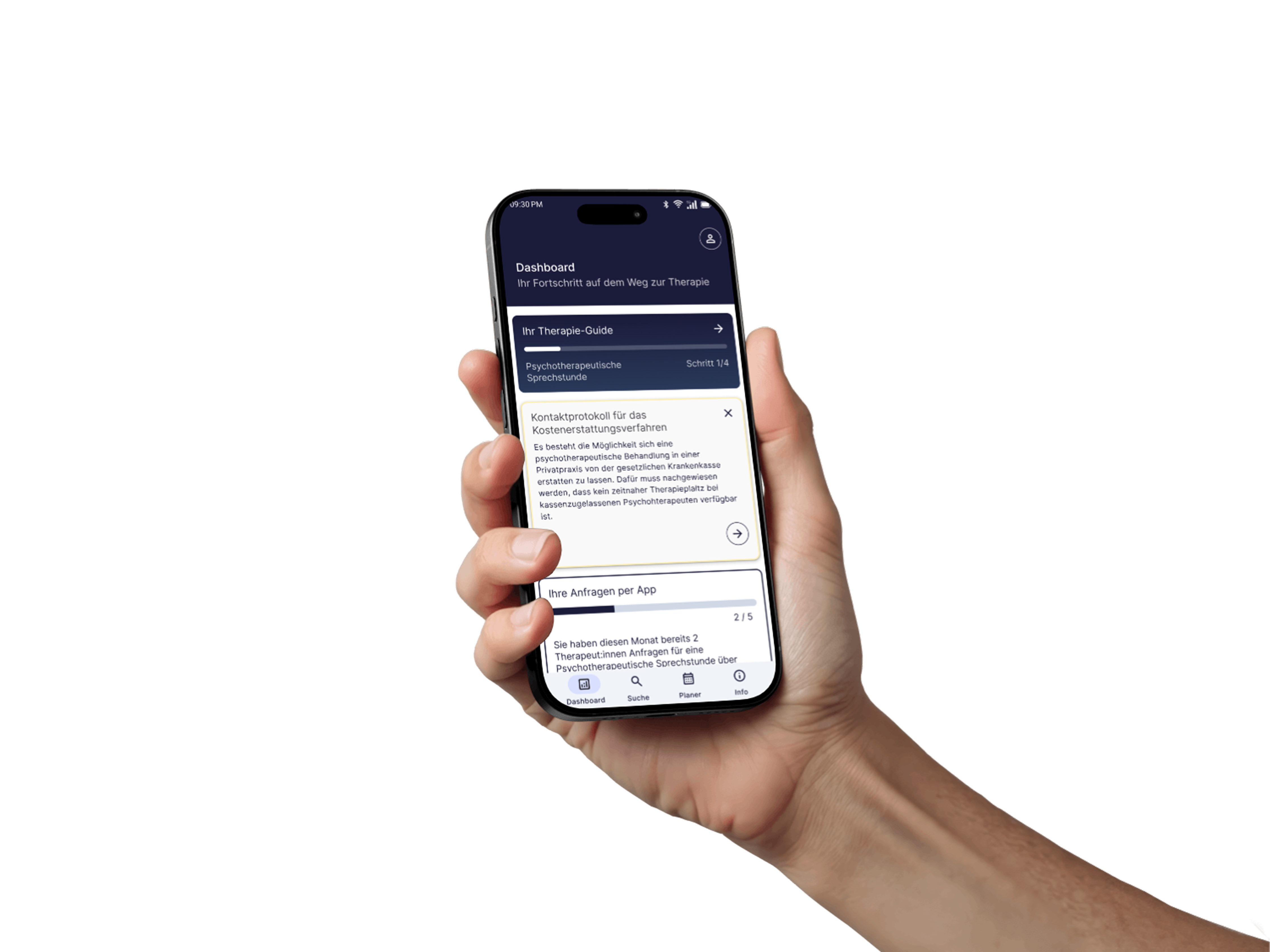
Patient side: dashboard, therapy guide for first-time users, preferences flow, availability matching, therapist search with filters, therapist profiles, planning tool, FAQs, contact log, and curated resource links. This should help to not only search for therapists but also to be guided through the whole process while managing the contact attempts.
Therapist side: settings for appointment allocation, intake configuration, questionnaire management, opening hours, a calendar with confirmation flow, an inquiry inbox, and a waitlist with patient profile access. This should hepl to reduce administrative load without removing therapist control.

.png)


Evaluation
The prototype was tested in moderated user sessions with both groups. Findings were structured along strengths and problems for each side.
Patients responded well to the guided structure and the transparency of the search process. However, they flagged friction in the preferences flow and the therapy guide entry point.
Therapists valued the calendar and intake configuration, but the waitlist functionality and some settings paths needed rework.
Iteration - Second Prototype
Based on the test findings, key flows were redesigned in a second iteration:
Patients:
- Restructured dashboard and FAQs
- Reworked preferences flow and therapy guide
- Redesigned availability matching
Therapists:
- Settings split into clearer sections (location, working methods, intake)
- Waitlist with added filter logic
- Refined calendar interaction


Outcome & Reflection
The thesis demonstrates that meaningful improvement in psychotherapy access is possible through design, but only when it respects the regulatory and operational constraints of the German healthcare system.
Some patient-side wishes, like a direct waitlist request function, are currently not legally feasible, which itself is a design finding worth surfacing. However, a guidance through the process is already a big improvement as patient's struggle to find and organize all the information themselves.
For therapists, a big improvement would be the structured handling of requests as they get so many that are manual handling is nearly impossible. Also structured and automated questionnaires can already reduce the manual workload a lot.
More work.